Spindale sits on red clay that holds water, swells, then shrinks hard when it dries. That movement stresses footings, piers, and slabs. Add high humidity, older pier-and-beam homes in the Spindale Mill Village, and frequent summer storms, and drainage becomes the first line of defense against foundation damage. Functional Foundations sees the same pattern across the 28160 zip code: water collects where it should not, soils shift, and homes settle.
Why drainage fails in Spindale’s red clay
Red clay drains slowly. After heavy rain, water lingers along foundations since the clay seals tight. Hydrostatic pressure builds against basement walls and crawl space block walls. Gutters discharge too close to the house or clog with leaves from mature trees along Old Main Street and Tanner Street. Downspouts dump on short splash blocks that do little on sloped yards near the Thermal Belt Rail Trail. Over time, the soil next to the foundation cycles between expansion and contraction, which causes settlement, stair-step cracking, and gaps at window and door frames.
Historic mill homes often sit on shallow footings or stacked piers with limited drainage planning. Modern homes can struggle too if grading slopes back to the structure or if sump pumps cannot keep up during storm bursts. These are predictable, fixable issues with the right combination of soil management and structural repair.
The chain reaction: from standing water to structural movement
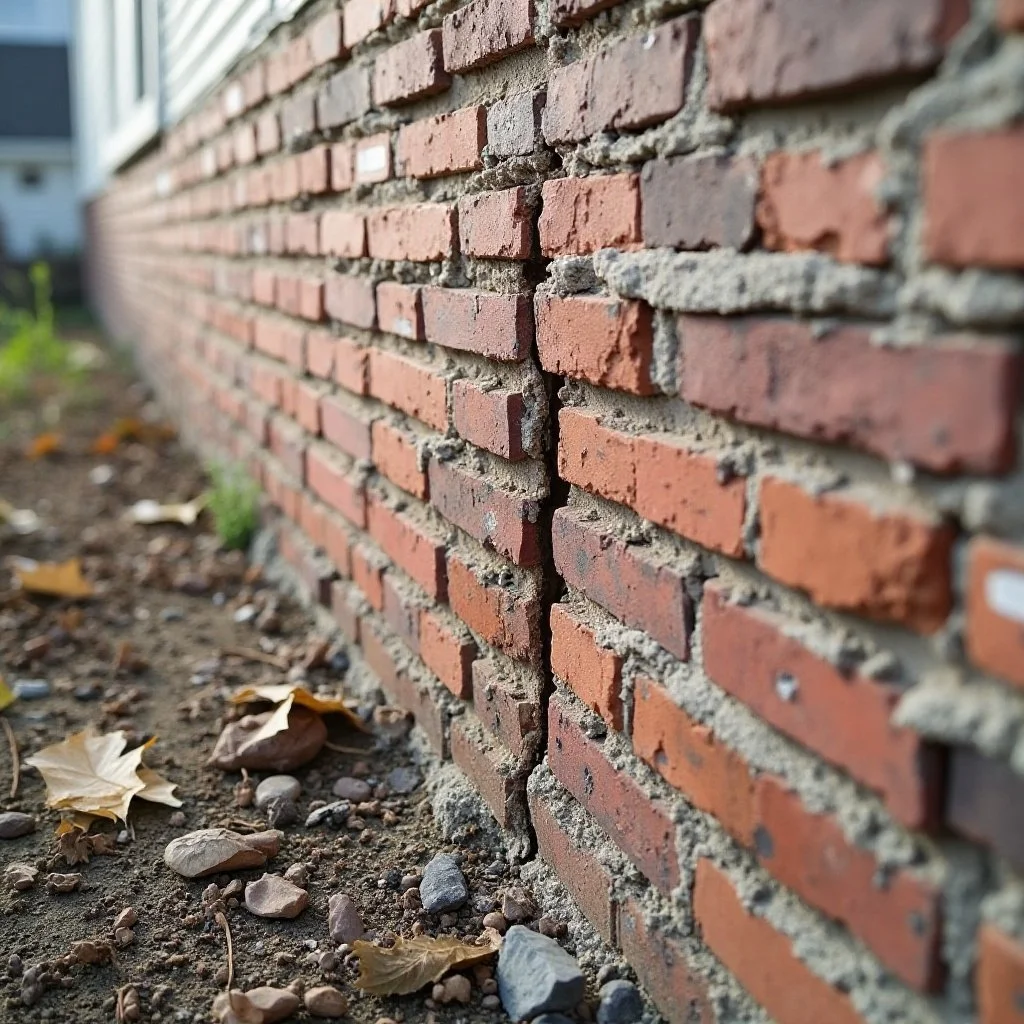
Water collects next to the foundation. Soils swell and press laterally on block walls. That pressure bows basement walls or pushes mortar joints open. When the yard dries, the clay shrinks, and the foundation loses support on one side. Floors begin to slope. Doors rub or stick. Brick shows stair-step cracks, especially around corners and above lintels. Efflorescence appears on interior block walls, a white powder that signals moisture transport through masonry. In crawl spaces, high humidity feeds wood rot and invites termites, which weakens joists and leads to bouncy floors.
In Rutherford County, this cycle is common after several rain events. It does not take a flood to trigger movement. Even a few inches of rainfall, held in clay, can raise hydrostatic pressure enough to bow a wall a fraction of an inch. Over a season or two, that fraction adds up.
Signals homeowners in Spindale should watch
Cracks and floor changes matter most. Brick stair-step cracks that widen to a nickel indicate differential settlement. Diagonal drywall cracks above doors point to racking. Perimeter gaps between soil and slab show shrinkage and loss of support. In crawl spaces, musty odors, damp insulation, and visible condensation on ductwork suggest humidity control issues. A moisture meter reading above 16–18% in floor joists means risk for rot.
Around the exterior, look for mulch beds that sit above the foundation weep holes, gutters that overflow during a storm, or downspouts that stop within three to five feet of the house. Standing water near the foundation 24 hours after rain is a red flag.
How poor drainage produces different types of foundation damage
Basements and daylight lower levels often see bowing walls due to hydrostatic pressure. Carbon fiber straps can restrain early bowing; worse cases may need wall anchors or interior braces. Slab-on-grade homes tend to settle at corners or garage slabs where runoff concentrates. Pier-and-beam homes develop sagging floors when moisture softens supports and soils sink under pads or short piers.
In Spindale’s Main Street Historic District and near the Spindale House, many homes have crawl spaces with low clearance and limited ventilation. High humidity encourages efflorescence and rot. Without a vapor barrier and dehumidification, seasonal swings are hard on structural wood.
Practical drainage fixes that work in 28160
Functional Foundations starts with water management. The crew evaluates grading, gutter capacity, and discharge points around properties near Isothermal Community College and along the Thermal Belt Rail Trail. Simple changes often deliver quick wins. Extending downspouts to 10 feet, cutting back mulch elevation, and reshaping soil to a 5–6 inch drop over 10 feet from the foundation can reduce water loading.
For persistent seepage along the footing, a French drain with a filter fabric-wrapped perforated pipe and clean stone can intercept groundwater. In basements, an interior perimeter drain paired with a high-capacity sump pump moves water to daylight or a storm outlet. In crawl spaces, a sealed vapor barrier and dehumidifier limit moisture that would otherwise keep the clay damp and expanded.
Structural stabilization once the soil is managed
Drainage prevents future movement, but it does not lift a settled footing back into position. For that, the team installs load-transfer systems. Galvanized steel push piers are driven to competent strata, then brackets connect the footing to the pier. Hydraulic lifts can recover elevation within practical limits and stabilize the structure against further settlement. Where clay depth varies across Spindale, CHANCE helical piers offer strong performance in variable soils because they screw into load-bearing layers with predictable torque readings.
Bowing walls respond well to Rhino Carbon Fiber straps if bowing is minor to moderate. More severe deflection may call for push braces or anchors, but the decision depends on wall thickness, block condition, and measured movement.
Crawl space solutions for humid Rutherford County
Crawl space encapsulation is effective in Spindale’s climate. A continuous vapor barrier seals the ground, seams are taped, and piers are wrapped to prevent moisture wicking into wood. Support jacks can re-level sagging girders. A Santa Fe or Aprilaire dehumidifier maintains relative humidity near 50%. Where water enters during storms, a Zoeller or Liberty sump pump with a basin and check valve manages peaks. This combination protects joists and subflooring, reduces odors, and helps doors operate smoothly.
Real examples from nearby streets
A pier-and-beam home near the Spindale Mill Village had doors that would not latch and a floor drop of about 1 inch across 15 feet. The yard sloped in, and gutters dumped at the corners. After extending downspouts, regrading, and sealing the crawl space with a vapor barrier, the crew added support jacks under the main girder. The floor improved immediately, and follow-up moisture readings dropped from the low 20s to the mid-teens.
A brick ranch near Old Main Street showed stair-step cracks and a sinking porch. Push piers along the affected wall transferred the load to stable soils, allowing a careful lift that closed cracks by several millimeters. A French drain and sump system now handle runoff that used to pool along the front bed.
Materials and brands that hold up in Spindale clay
Engineered solutions matter as much as workmanship. Functional Foundations uses CHANCE Helical Pier systems for deep, consistent bearing in layered soils. Heavy-duty galvanized steel push piers provide reliable end-bearing support. Rhino Carbon Fiber professional foundation repair in NC reinforces bowing walls without bulky beams. SafeBasements drainage components integrate cleanly with interior channels. For moisture control, Santa Fe and Aprilaire crawl space dehumidifiers run efficiently, and Zoeller or Liberty sump pumps deliver dependable discharge during storm surges.
What to expect during a structural evaluation
A licensed North Carolina contractor inspects the structure inside and out, checks elevations, and documents cracks. Moisture and humidity readings guide waterproofing and encapsulation plans. If major structural work is needed, stamped engineering reports are provided. Most residential projects in Spindale take two to four days, depending on pier count, access, and weather.
Service coverage across Rutherford County
Functional Foundations serves Spindale and nearby communities, including Rutherfordton 28139, Forest City 28043, Ruth, Gilkey, Alexander Mills, Union Mills, and Lake Lure. Crews are often seen stabilizing homes near Isothermal Community College, WNCW, and the Foundation Performing Arts Center. The company understands the pier-and-beam nuances of historic properties in the Spindale Mill Village and the moisture behavior of red clay across the 28160 area.
Why homeowners choose Functional Foundations
The company offers free structural evaluations and financing options. It is locally owned and operated, BBB accredited, and a North Carolina Licensed General Contractor. Piering systems come with a lifetime transferable warranty. The team provides structural engineering support for major repairs and stands behind the work long term.
When to call for foundation repair in Spindale, NC
If stair-step cracks widen, floors slope, doors rub, or crawl spaces smell musty, water is likely playing a role. Early intervention reduces repair scope and cost. Schedule a no-obligation foundation inspection to identify the root cause of settlement and moisture. Functional Foundations provides foundation repair Spindale NC homeowners can trust, using engineered piering, waterproofing, and soil solutions built for Rutherford County’s red clay.
Quick homeowner checklist
- Confirm gutters are clean and sized correctly for roof area. Extend every downspout at least 10 feet from the foundation. Regrade soil to slope away 5–6 inches over the first 10 feet. Inspect for interior cracks, sticking doors, and sloping floors after heavy rain. Check crawl space humidity and add a vapor barrier if bare soil is exposed.
FAQs for Spindale homeowners
Are you licensed in North Carolina? Yes. The company is fully insured and NC licensed.
Do you offer warranties? Yes. Piering systems include lifetime transferable warranties.
How long does the repair take? Most Spindale residential projects finish in 2–4 days.
Do you serve the 28160 zip code? Yes. The team provides expert structural assessments throughout 28160.
What brands do you use? Rhino Carbon Fiber for wall reinforcement, SafeBasements drainage, and CHANCE Helical Piers to bypass unstable Spindale clay.
Call to schedule a free structural evaluation. From the historic homes near the Spindale Mill Village to newer builds by the Thermal Belt Rail Trail, Functional Foundations delivers engineered solutions that stop drainage-driven damage and stabilize homes across Spindale.
Functional Foundations provides foundation repair and restoration services in Asheville, NC, and nearby areas including Hendersonville and Spindale. The team handles foundation wall rebuilds, crawl space stabilization, subfloor replacement, floor leveling, and steel-framed deck repair. Each project focuses on stability, structure, and long-term performance for residential properties. Homeowners rely on Functional Foundations for practical, durable solutions that address cracks, settling, and water damage with clear, consistent workmanship.
Functional Foundations
Asheville, NC, USA
Phone: (252) 648-6476
Website: https://www.functionalfoundationga.com, foundation repair Spindale NC
Map: View on Google Maps